How to choose the right first aid kit?
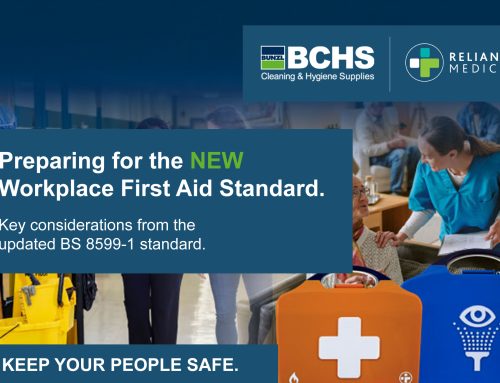
Choosing the right first aid kit for your workplace starts with understanding your legal responsibilities. In the UK, access to appropriate first aid equipment isn’t optional – it’s a requirement enforced by the Health and Safety Executive (HSE), which mandates that employers provide adequate first aid provision based on workplace risk. The recognised UK standard, BS8599-1:2019, sets out clear guidance on the recommended contents of workplace first aid kits, taking into account risk level, workplace size, and the number of employees and visitors on site. Whether you operate from an office, warehouse, construction site, care setting, or company vehicle, selecting the correct first aid kit is essential for protecting people and maintaining compliance with health and safety legislation.
Click here to view the first aid kit options
Legal obligations for employers
All employers have a legal duty of care to protect the health and safety of their workforce, including those working off-site or in company vehicles. This responsibility includes:
- Carrying out a first aid needs assessment
- Providing suitable first aid kits for the working environment
- Ensuring kits are easily accessible
- Regularly checking contents and replacing expired items
Failure to meet these requirements could leave employees exposed to unnecessary risk – and employers open to compliance issues.
Consider the risk level
Workplaces are generally classified as low risk or high risk, which determines the type of size of the kit required:
- Low-risk environments (such as offices or shops)
- Typically requires a medium kit for up to 100 employees
- High-risk environments (such as construction sites or manufacturing facilities)
- Often requires a medium kit for 5 – 25 employees
Workplace size and employee numbers
Larger workplaces – particularly those spread across multiple floors or areas – will usually require multiple first aid kits. Kits should be positioned in clearly signposted, easily accessible locations to ensure rapid response in an emergency.
Lone workers and personal first aid kits
Employees who work alone or in isolated, higher-risk environments — such as security staff, engineers, or maintenance workers — should be issued with personal first aid kits.
For roles involving hazardous machinery, chemicals, or tools, specialist kits, such as critical injury or trauma kits, may also be required to manage more serious incidents until help arrives.
Do company vehicles need first aid kits?
Yes — every company vehicle should carry a compliant first aid kit. The recommended kit size depends on the vehicle type and passenger capacity:
- Small kits – Motorcycles, tricycles, or vehicles with up to 3 passengers
- Medium kits – Cars, vans, taxis, and trucks (up to 8 passengers)
- Large kits – Minibuses and coaches (up to 16 passengers)
Checking expiry dates and maintaining compliance
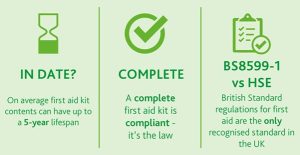
First aid kits are not “fit and forget”. Under BS8599-1:2019, employers must ensure kits are:
- Fully stocked
- Free from damaged items
- Within product expiry dates
Most first aid components have a shelf life of up to five years, making routine checks essential to maintain both compliance and effectiveness.
Addressing workplace‑specific hazards
Different working environments present different risks. Your first aid provision should reflect these hazards:
- Construction sites – Falls, crush injuries, burns, and eye injuries
- Offices and care homes – Slips, trips, minor burns, and falls
- Warehouses – Trips, falls, forklift incidents, falling objects
- Kitchens – Burns, cuts, scalds, and eye injuries
When to use burn kits
Burn injuries are common in kitchens and workplaces involving heat, hot liquids, or open flames. Burns are categorised as:
- Superficial burns – Red, dry skin without blisters
- Partial thickness burns – Red, blistered, swollen skin
- Full-thickness burns – White or charred skin
For partial or full‑thickness burns, emergency services should be contacted immediately. A burns kit containing hydrogel dressings can help cool the burn, limit tissue damage, and support recovery until further treatment is available.
Biohazard first aid kits: when are they needed?
Workplaces such as healthcare facilities, schools, and veterinary practices may be exposed to bodily fluids and other biological hazards.
A biohazard kit typically includes gloves, aprons, absorbent materials, disinfectants, and clinical waste bags — helping protect staff from infection and ensuring safe, compliant clean‑up.
Bleed control and critical injury kits
High‑risk environments, including construction sites and public venues, should consider critical injury or trauma kits to manage severe bleeding and traumatic injuries.
These kits may include:
- Haemostatic dressings
- Trauma bandages
- Tourniquets
- Foil blankets to prevent shock
Using a critical injury kit:
- Protect yourself with gloves
- Expose the wound using trauma shears
- Apply a tourniquet if required
- Keep the casualty warm until emergency services arrive

AEDs: vital life‑saving equipment
Sudden cardiac arrest can happen anywhere, and survival rates decrease by approximately 10% for every minute without intervention. Automatic External Defibrillators (AEDs) play a critical role in improving outcomes.
However, accessibility is just as important as availability. AEDs must be visible, secure, and ready for immediate use.
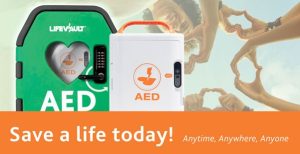
LifeVault Cabinets provide robust protection for AEDs in both indoor and outdoor environments, safeguarding against weather damage, vandalism, and temperature extremes. With high‑visibility design and optional alarm systems, LifeVault cabinets help ensure AEDs can be located and accessed quickly when every second counts.
Conclusion: Compliance protects people
Ensuring your workplace meets first aid compliance requirements isn’t just about meeting regulations — it’s about protecting people.
By assessing your risks, choosing the right first aid equipment, and maintaining your supplies, you can create a safer environment for employees, customers, and visitors alike.
Safety should never be an afterthought. Make sure your workplace is prepared for the unexpected.