The transport sector remains a significant contributor to greenhouse gas (GHG) emissions, accounting for approximately 25% of the UK’s total emissions. Within Europe, road transport alone constitutes 73.2% of transport-related emissions, according to the European Environment Agency (EEA). Tackling this means rethinking not only how we travel but what fuels our journeys.
What is HVO Fuel?
Hydrotreated Vegetable Oil (HVO) is a renewable diesel alternative, produced through the hydrotreatment of waste fats, used cooking oils, and other non-food feedstocks. It can be used in pure form (B100) or blended with petroleum diesel in varying proportions (B2, B5, B20). Notably, it’s biodegradable and non-toxic making it a cleaner, greener substitute for conventional diesel – and the best part? For many engines, HVO is a drop-in fuel, meaning it can be used without any modifications.
Why HVO Matters
To understand why HVO is such a game-changer, we need to talk about life cycle emissions. That’s the total carbon impact of a fuel, from sourcing and production to combustion in your engine.
Let’s break it down:
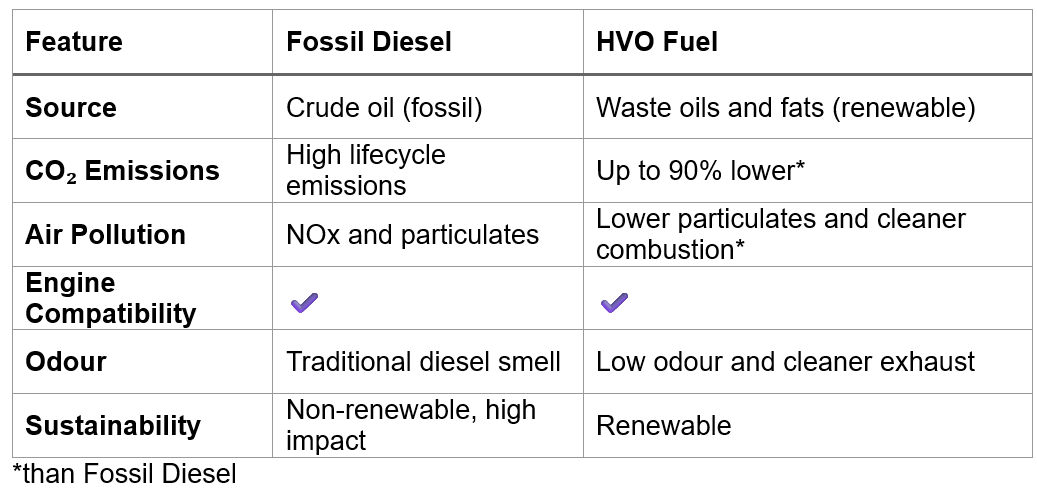
HVO’s emissions benefits arise from its sustainable feedstock sources. Unlike fossil diesel, which releases ancient carbon long stored underground, HVO is produced from renewable materials already circulating within the modern carbon cycle. This means it avoids introducing “new” carbon into the atmosphere, resulting in a substantial reduction in net greenhouse gas emissions. In fact, HVO can deliver up to a 90% decrease in CO₂ emissions, positioning it as a powerful low-carbon alternative for the transport sector.
HVO and Biodiesel: Not All Biofuels Are Equal
While traditional biodiesel has gained traction, it often relies on virgin crops such as palm, soy, or rapeseed, raising concerns over land use, water consumption, and food security. In contrast, HVO offers a more sustainable profile:
- Made from waste, not crops
- Supports circular economy principles
- Reduces reliance on fossil fuels
- Helps the UK hit its target to cut oil and gas use by 50% by 2030
Used cooking oil (UCO), in particular, is gaining attention as a sustainable feedstock. It’s cheap, readily available, and aligns with RED II (Renewable Energy Directive II) sustainability criteria for GHG emissions, biodiversity protection, and preservation of high-carbon stock areas.
Our Journey: Transitioning to HVO Across UK Operations
As part of BCHS’s commitment to reducing carbon emissions and driving sustainable operations, our company has officially begun transitioning from fossil diesel to HVO across our UK transport fleet. This initiative supports our broader environmental objectives and aligns with national targets to cut oil and gas usage by 50% by 2030.
In 2024, we began the rollout to HVO, beginning with our Castleford and Croydon branches. Building on this momentum, we expanded the rollout in 2025 to include two additional sites: Langley and Warrington.
By the end of March 2025, BCHS has consumed over 68,000 litres of HVO, significantly reducing our carbon footprint and demonstrating our commitment to sustainable fuel alternatives. If this same volume had been fossil diesel, it would have generated an estimated 170 tonnes of CO₂. Thanks to HVO, our actual emissions were just under 2 tonnes, resulting in savings of 168 tonnes of CO₂
We’re proud to share that 90% of our UK branches are projected to be operating on HVO by the end of 2025, driving further reductions in our environmental impact.
This transition not only contributes to improved local air quality and reduced lifecycle emissions but also positions our business as a leader in low-carbon transport solutions within the logistics and distribution sector.
Final Thoughts
In the race to decarbonise transport, HVO is more than an alternative fuel—it’s a strategic opportunity. Its ease of implementation, environmental benefits, and growing availability make it an ideal stepping stone on the path to net zero.
At BCHS, we believe in taking action that delivers real results. Our transition to HVO is just one part of our wider sustainability mission—but it’s one that’s already making a measurable difference.
Find out more by visiting: https://www.bunzlchs.com/sustainability